


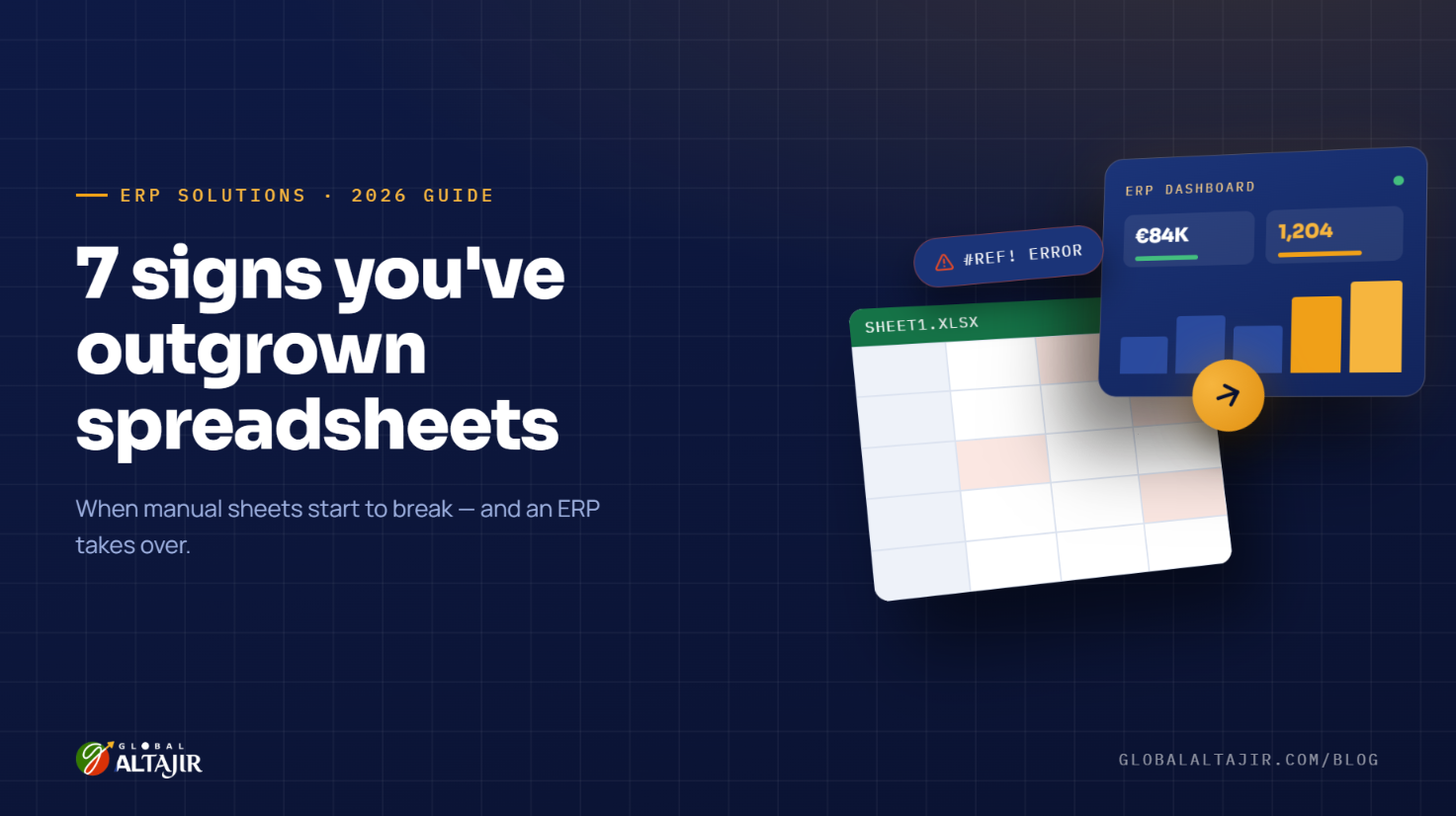
7 Signs Your Business Has Outgrown Spreadsheets and Needs an ERP System (2026 Guide)
Every business starts the same way. A spreadsheet for sales. Another for inventory. One more for expenses. An inbox full of supplier emails. A WhatsApp group for the team.
It works — at first. And then, quietly, it stops working. Not all at once. It happens order by order, hire by hire, until one day you realise you are spending more time managing your tools than running your business.
Enterprise Resource Planning (ERP) software exists to solve exactly this problem. It brings every core function of your business — finance, inventory, sales, purchasing, HR, and reporting — into a single connected system with one shared database and real-time visibility across all of it.
But ERP is not needed on day one. The question most business owners ask is: when is the right time? Here are seven signs that time is now.
Sign 1: You Manage Your Business Across Five Different Tools — and None of Them Talk to Each Other
QuickBooks for accounting. A spreadsheet for inventory. A separate CRM for customers. WhatsApp for team communication. Email for supplier orders. A different spreadsheet — probably the most chaotic one — for monthly reporting.
This is the "spreadsheet stack" that most growing businesses are running on, and the problem is not any individual tool. The problem is the gaps between them. When your sales system does not know what your inventory holds, you oversell. When your accounting software does not connect to your purchasing system, invoices fall through. When your reporting is a manual exercise of pulling numbers from five places, you are always working with data that is already out of date by the time you read it.
ERP removes the gaps. Every transaction, every order, every stock movement and every invoice updates a single shared database that every part of your business reads from. Data entered once flows everywhere it needs to go — automatically.
Sign 2: You Cannot Answer Simple Questions About Your Business Without Digging
Here is a test. Without opening multiple tabs, files, or asking a team member — can you answer these right now?
- What is your current cash position?
- Which of your products has the highest profit margin?
- Which customers owe you money, and how overdue are they?
- How much stock do you have of your top-selling item, and when will it run out?
- What did your business spend on purchasing last month?
If the honest answer to any of these is "I would need to check," your business is making decisions on incomplete information. In a competitive market, that delay — even by hours — affects pricing decisions, purchasing decisions, and customer commitments. A properly implemented ERP provides real-time dashboards where every one of these answers is visible at a glance.
Sign 3: Your Team Spends Significant Time Re-Entering the Same Data Into Different Places
A customer places an order. Someone enters it into the sales system. Someone else updates the inventory spreadsheet. A third person creates the invoice in the accounting software. A fourth sends the dispatch instruction to the warehouse by email.
Each of those steps is an opportunity for a typo, a missed update, a version conflict, or a delay. And the cumulative cost is significant. Research across small business ERP implementations consistently shows teams recovering 15 to 20 hours of manual data entry per week after going live on an integrated system. Multiply that by your average hourly labour cost and compare it to what an ERP subscription costs per month.
Sign 4: Your Inventory Is a Source of Constant Surprises
You promised a customer a delivery date based on stock levels you thought you had. Then you discovered the warehouse had a different count. Or stock that was listed as available had already been allocated to a different order. Or a purchase order you thought had been placed had not been.
Inventory problems are one of the clearest signals that manual tools have hit their limit. They are also one of the most expensive — stockouts damage customer relationships, overstocking ties up working capital, and shrinkage goes undetected without proper tracking. ERP inventory modules provide real-time stock levels, automatic reorder triggers when quantities hit defined thresholds, and a clear audit trail of every stock movement.
Sign 5: Month-End Closing Takes Days and Still Produces Numbers You Are Not Confident In
In a business without integrated systems, month-end closing is an exercise in reconstruction. Pulling data from accounting, cross-referencing against inventory, checking sales records, chasing team members for missing invoices, and eventually producing a P&L that everyone hopes is accurate.
In an ERP-managed business, month-end closing becomes a process of verification rather than construction. Because every transaction has been logged in real time as it happened, financial reports are generated in minutes. The question shifts from "what are our numbers?" to "what do our numbers mean?"
Sign 6: You Are Entering a New Market, Scaling to a New Country, or Taking On EU Clients
This is the sign most relevant to entrepreneurs expanding from the Gulf or South Asia into the European market — and it is the one most often overlooked until problems emerge. Operating across borders introduces complexity that spreadsheets and disconnected apps cannot handle reliably:
- Multi-currency transactions: Invoicing in EUR while your costs are in AED or USD requires accurate currency conversion, exchange rate tracking, and proper accounting treatment.
- VAT compliance: EU VAT rules are complex, jurisdiction-specific, and enforced with penalties. Lithuania requires VAT registration at €45,000 annual turnover, with monthly or quarterly filing obligations.
- Multi-entity reporting: If you operate both a UAE entity and a Lithuanian company, you need consolidated visibility across both structures.
- Audit readiness: EU regulatory environments, including the Lithuanian State Tax Inspectorate (VMI), require businesses to maintain detailed, accurate transaction records. An ERP produces an audit trail automatically.
- Client expectations: European enterprise clients expect professional invoicing, formal documentation, and system-generated purchase order management that manual processes cannot reliably deliver at scale.
Sign 7: You Are About to Hire, Seek Financing, or Bring On a Business Partner
Banks and investors do not trust spreadsheets. They look for structured financial data, consistent record-keeping, and evidence that the business has operational controls in place. A business running on ERP can produce standardised financial statements, cash flow reports, inventory valuations, and sales history on demand.
Similarly, bringing on employees to manage functions that are currently informal requires documented processes. ERP provides the workflow structure that makes delegation possible without loss of control — a purchase order requires approval, a stock adjustment requires authorisation, an invoice requires matching against a delivery record.
What to Look for in an ERP System for a Growing Small Business
Not every ERP is designed for a business at your stage. Before evaluating vendors, define your requirements clearly:
- Cloud-based, not on-premise: Cloud ERP requires no server infrastructure and is accessible from any device or location. For a business with teams across multiple countries or time zones, this is non-negotiable.
- Modular pricing: Buy the modules you need now (finance, inventory, sales) and add HR, project management, or e-commerce integration as you grow. Avoid paying for features you won't use yet.
- Multi-currency and VAT support: Essential for any business operating across the EU or between the Gulf and Europe.
- API integrations: Your ERP should connect to the tools you already use: your e-commerce platform, your payment gateway, your bank feeds, your CRM.
- Implementation support: The technology itself is only part of the equation. Work with a partner who understands your industry and your business model.
The Global ALTAJIR Approach: ERP Included
At Global ALTAJIR, we recognised early that the biggest barrier to ERP adoption for growing small businesses is not the technology — it is the perceived cost and complexity of getting started.
That is why we include a fully implemented ERP solution at no additional cost for every client who subscribes to our Digital Marketing package. Not a trial. Not a cut-down version. A complete, configured ERP deployment for your business, set up by our team and ready to use from day one.
This means:
- Inventory management connected to your sales pipeline
- Financial reporting that reflects every transaction in real time
- Purchase order management with approval workflows
- Customer and supplier records in a single database
- Multi-currency support for EU and non-EU operations
- A foundation that scales as your business does
The Bottom Line: Spreadsheets are not the enemy. They are the right tool for the right stage. But there is a stage at which they become the ceiling — the thing that stops you from seeing your business clearly, managing it confidently, and growing it without chaos.
Ready to Break Through the Growth Ceiling?
Whether you are managing a newly registered Lithuanian company, scaling an e-commerce operation across Europe, or building the operational backbone of a business that is growing faster than your current tools can handle — this is where you start.
📩 Schedule Your Setup: Book a free consultation & live demo
💡 Bundle Details: Explore Digital Marketing + Free ERP Bundle
📞 WhatsApp: +971 54 569 0799
📧 Email Support: support@globalaltajir.com