


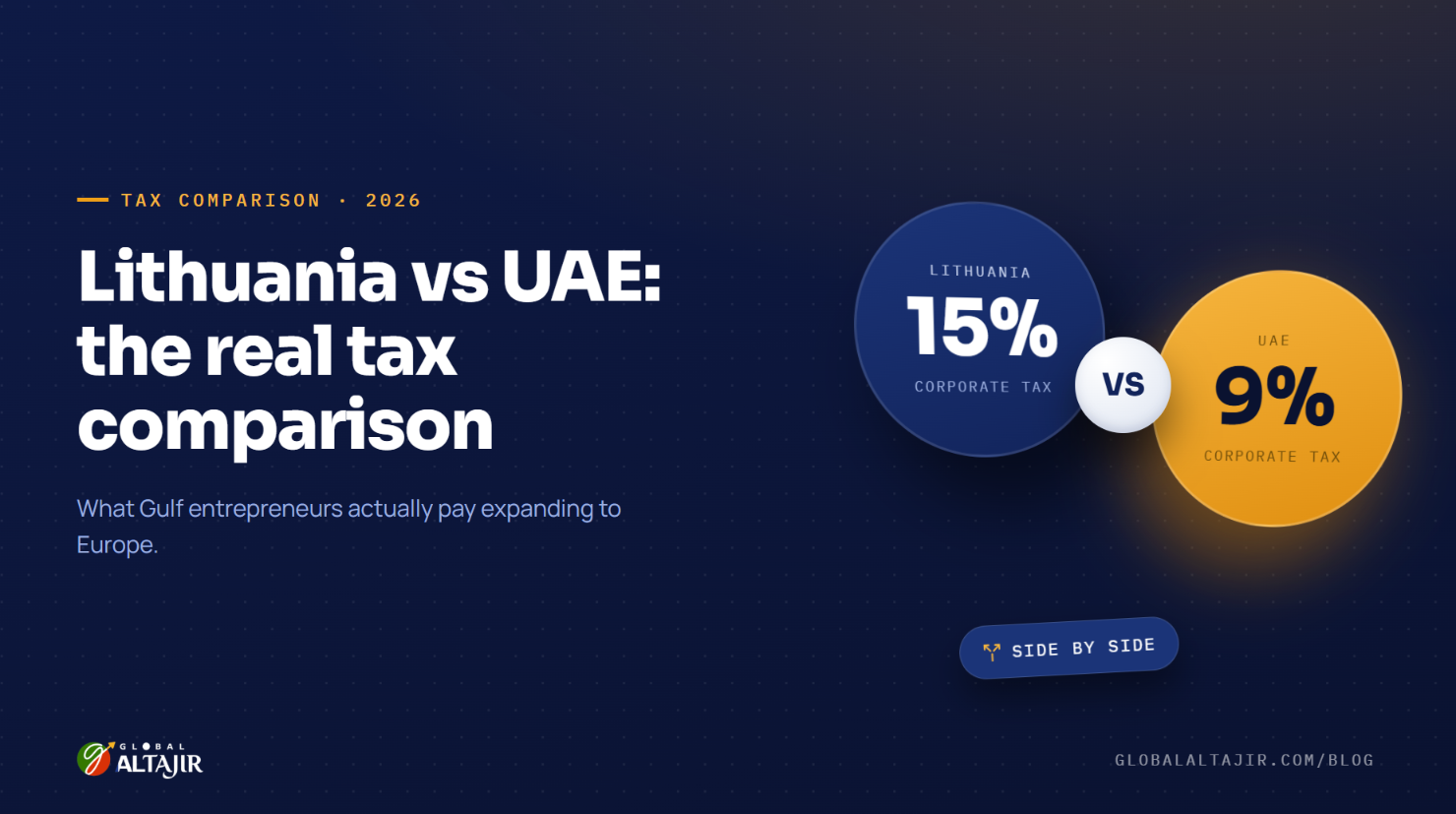
Lithuania vs UAE: The Real Tax Comparison for Gulf Entrepreneurs Expanding to Europe (2026)
There is a belief deeply embedded in the Gulf business community: the UAE is a tax haven, and Europe is expensive. Register in Dubai, keep your taxes at zero, and grow from there.
However, the game changed when the UAE introduced federal corporate tax. The Federal Tax Authority is actively auditing returns, issuing penalties, and closing corporate gaps that many free zone companies assumed would remain open forever.
Meanwhile, Lithuania—one of the EU’s most advanced and digital-friendly hubs—offers a 0% corporate tax rate for new companies for their first two years, a 7% rate for small businesses, and total access to the European single market. Let’s look at the side-by-side realities.
⚖️ UAE Corporate Tax Regime
- Mainland Rates: 0% up to AED 375,000 (~€93,000), and 9% on anything above.
- Free Zone (QFZP) Trap: To keep a 0% rate on qualifying income, you must satisfy 5 strict annual conditions, manage transfer-pricing rules, and perform a mandatory annual audit regardless of company size. Failing just one condition triggers a blanket 9% tax rate for 5 consecutive years.
- Small Business Relief (SBR): The AED 3 million relief program acts as a transitional structure and is scheduled to expire at the end of December.
🇪🇺 Lithuania Tax Framework
- Startup Rate: A clear, guaranteed 0% corporate income tax (CIT) for your first two tax periods of operation (provided gross revenue stays below €300,000).
- Small Business Preferential Rate: Only 7% flat on taxable profit if annual revenues remain under €300,000.
- Standard CIT: 17% for major companies, scaled down heavily by newly implemented "instant depreciation" laws on software, machinery, and physical assets.
- VAT Threshold: 21% standard VAT rate, with mandatory registration kicking in at a €45,000 turnover ceiling.
Side-by-Side Comparison
| Factor | UAE Free Zone (QFZP) | Lithuania (Small Co.) |
|---|---|---|
| CIT Rate | 0% (Strict qualifying terms) | 7% (or 0% for first 2 years) |
| Annual Audit | Yes — Mandatory | No (Under threshold) |
| Setup Cost | $3,000 – $8,000+ | ~€1,000 – €2,500 |
| EU Single Market | No Access | Full Access + SEPA |
| Residency Path | No EU Access | Yes (Entrepreneur Visa) |
The Verdict: Where Does Your Business Win?
The ideal structure depends entirely on your target audiences and cross-border objectives:
- The UAE Wins If: Your clients reside primary within the MENA markets, you value zero personal income tax, or your scaling corporate earnings safely cross the €300,000 point where the UAE's flat 9% system edge-competes standard EU tax limits.
- Lithuania Wins If: You want to frictionlessly close enterprise clients in Europe, your business model falls under early stage or startup criteria (benefiting from the initial two-year 0% tax holiday), or you intend to establish a physical pathway to an EU residency permit.
- The Power of Dual Structures: Most fast-growing Gulf teams combine both paths. Keep your UAE establishment for regional GCC interactions, and deploy a Lithuanian vehicle with a localized European IBAN to clean up SaaS, e-commerce, or European consumer revenues.
Optimise Your International Corporate Setup
Don't let complex cross-border regulations stall your expansion. At Global ALTAJIR, we design interconnected UAE and European frameworks to shield your assets, minimize tax exposures, and activate fully remote banking setups.
The tax landscape has structurally flipped. Smart entrepreneurs in the Gulf space are expanding beyond one single market framework, setting up strategic operational footprints where the fiscal parameters support them the most.